Last weekend I headed up to Taipei to attend the Fulbright Taiwan orientation/welcome activities. I technically already attended an orientation in DC back in July but that one was for ETAs only so I was pretty excited to meet all the other Taiwan grantees (not to mention rubbing elbows with all the political big wigs from the American Institute in Taiwan or AIT, which is basically the unofficial Taiwanese version of an embassy). Also, getting a free trip to Taipei was a definite plus.
 |
| Arriving in style with my Yilan homegirls |
We had an opening reception/dinner on Friday night at the old (as in occupation era) Japanese Mayor's house in downtown Taipei. Getting to see all of the ETAs from Kaohsiung again and comparing teaching/life in Taiwan stories was really great. And there are some researchers here on Fulbright doing some amazing work. There was no lack of interesting conversation. And then there was the fact that the food was awesome. I had an actual salad (which sounds silly but is a feat of work here in Taiwan), sashimi, and pasta with actual cheese! In other words, it was a good night.
 |
William A. Stanton, the director of AIT (basically the American
Ambassador to Taiwan except that Taiwan is not officially
allowed to have ambassadors) |
On Saturday, we were officially received at both the Aboriginal Museum in Taipei and the National palace Museum (okay, I'm bragging a little bit here but sometimes it's nice to be a big, fancy, special "cultural ambassador").
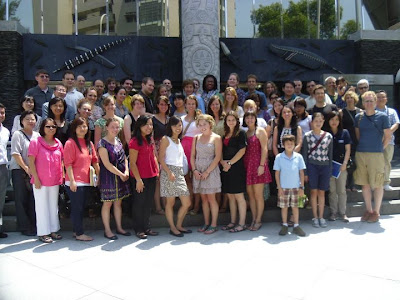 |
| The whole Fulbright group outside the Aboriginal Museum |
 |
| Fancy lunch |
 |
| The National Palace Museum |
Both museums were fantastic. I learned a lot about the history of the aboriginal tribes of Taiwan and where you can still go today to visit some of the tribes at the Aboriginal Museum. But I was especially excited about going to the National Palace Museum. It houses the world's largest collection of ancient Chinese artifacts and artworks.
Quick history lesson: Most of the pieces currently in the museum were collected by China's ancient emperors over the last 8,000 years or so but, after the last emperor was dethroned in 1925, the collection fell into the hands of the new Nationalist Government under Chiang Kai-sheck. When the Japanese invaded in the 1930s, the government ordered the most valuable pieces to be taken out of Beijing and hidden to keep them from the Imperial Japanese Army. Then, after WWII was over and the Japanese had left, the Chinese civil war broke out between Chiang Kai-sheck's Nationalists and Mao Zedong's Communists. As the fighting grew worse, the directors of the Palace Museum in Beijing decided to send some of the most important pieces in the collection to Taiwan for safekeeping. In the end, the National Palace Museum wound up with about a quarter of the original collection. In the end, this turned out to be a very good thing because much of what was left in China was destroyed in the during Mao's
Cultural Revolution between 1966 and 1976
. Today, there is still some debate surrounding the museum and it's collection. While the Chinese government argues that the collection was stolen and that it legitimately belongs in China, Taiwan defends the collection as a necessary act to protect the pieces from destruction, especially during the Cultural Revolution.
Okay, that's enough history for now. The point is, the museum is super interesting (especially if you're a history nerd like me) and it's collection is phenomenal. Unfortunately, there is no photography allowed in the museum but, if you're interested, you should check out the museum website by clicking
here. You can take a look at the exhibits or a virtual tour of the museum. Fun stuff!
After we left the museum, I decided to help a fellow Fulbrighter out with her project. Brenda Zlamany is an artist and a Fulbright senior scholar. For more on her art, you can visit her website at
http://brendazlamany.com/. Her current project is about "the Face of Taiwan." She's painting 888 (8 is a lucky number in Asia) watercolor portraits of people in Taiwan with a special emphasis on aboriginal areas and people.
 |
| Brenda's notebooks of paintings. She's completed about 650 so far. |
 |
Brenda's portrait of Vivian, one of Fulbright Taiwan's
many awesome staff members. She's pretty great. |
So we headed back to the Taipei Artist Village with Brenda and she painted me and 8 or 9 other volunteers on Saturday night.
 |
| Hard at work |
 |
| Ta-da! |
What do you think? Does it look like me?


